Wednesday, 2 November 2022

Essential Logic: Logically Yours.


The early years of Lora Logic have been well documented, given a tenor sax at thirteen by her Dad she answered an ad in the music press and in 1976 joined X-Ray Spex while only fifteen. She played on the debut single ‘Oh Bondage Up Yours’ and the Live at the Roxy album (from what I remember one of the highpoints) and arranges all the sax parts for X-Ray Spex first album, Germ Free Adolescents, before being ejected from the band.
Disillusioned with the music industry Lora entered St Martins Art College to study photography, while there she recorded ‘Aerosol Burns’ and ‘World Friction’ and formed Essential Logic. Their first single was released in 1978 with an EP, ‘Wake Up’ released the following year along with the first album Beat Rhythm News. In 1980 the band released four singles alongside extensive gigging.

Alongside Essential Logic Lora worked with The Stranglers, Red Crayola, The Raincoats, Scritti Politti, Swell Maps and Dennis Bovell and acted in, and composed music for, the film Crystal Gazing released in 1982, the same year her solo album Pedigree Charm was released.

Around 1980 Lora encountered an old friend who has become involved with the Hare Krishna movement and found the teachings answered questions she 'had buried’. She moved into the Soho Street Temple, Bhaktivedant Manor and Chaitanya College in Worcestershire for several years. In 1984 Lora started recording again and in 1995 teamed up again with Poly Styrene for a short lived X-Ray Spex reunion which produced the acclaimed album Conscious Consumer.

Lora continued to record and in 2003 Kill Rock Stars released a 2 CD compilation Fanfare in the Garden. I bought Fanfare in the Garden having heard a few Essential Logic and Lora Logic tracks and was completely amazed by the innovation and imagination. Park up all your reference points Essential Logic truly were original, one of the best examples of the bringing of avant-garde experimentation into pop culture that Gavin Butt identifies as a hallmark of post punk (1).

In the last couple of years Lora has been working on a new album and then a few weeks ago released a lead single/video, ‘Alien Boys’ from her new album Land of Kali and announced the November release of a 5 vinyl album box collection Logically Yours on Hiss and Shake Records which will include Beat Rhythm News, Pedigree Charm, two compilation albums (Aerosol Burns and Other Misdemeanors and No More Fiction) plus the new album. Listening to it is a reminder of just how surprising Essential Logic/Lora Logic were, I hadn’t heard the 1980 single ‘Eugene’ before, amazing! ‘Music is a Better Noise’, ‘Moontown’ ‘Fanfare in the Garden’, superb, soaring marvels. Hopefully at some point there may be a CD release?

The new album Land of Kali is a grower, it has a different sound to her early work of course and lyrically reflects Lora’s Vaishnava cosmology and faith. The first track is a new version of ‘Prayer for Peace’, a track originally recorded on Conscious Consumer, the song features Lora’s sax playing which really lifts the track; mellow and very beautiful.

Next track up is the lead single ‘Alien Boys’, Lora comments in the press release ‘A fun song with unnerving undertones. On planet lock down, I am overwhelmed by the feeling that normal people are being threatened by different kinds of alien boys with alien toys, propelling us into a dystopian future’ (2), great track.

The next three tracks. ‘Mother Earth’, ‘Never Know’ and ‘Charming Every Cupid’ are mellower, quite ethereal with elements of the latter track ‘Charming Every Cupid’ linking the new album back to Lora’s older material. 

Side 2 starts with ‘Sky Rocket’ co-written with her daughter Malini, reflects on ‘the fairground of life’ (2).

Next track ‘Serious’ is a bit of a rocker, again those Essential Logic vocals and sax are present, drawing you in. Good news is Lora’s voice has held up, her sax playing is still transcendent. My favourite track.

Title track, ‘Land of Kali’ starts with Lora’s sax and is cleverly juxtapositioned with the previous mellower track ‘Fallible Soldiers’ as this accentuates the driving rhythm and sax of ‘Land of Kali’. Again Lora’s voice sounds great.

‘Beyond’ starts with a bit of a disco thing going on and is basically a worship song (I think) and again features Lora’s sax playing.

You need to reorientate yourself a little when listening to Land of Kali, if you are hoping for Beat Rhythm News Part 2 this isn’t it because people move on, change, evolve but interestingly the more you listen to it the more there are certainly elements of continuity between Lora’s earlier work and this new album. Approach it on its own terms and you can appreciate it as a fine body of work from an artist who can still deliver.

Intrigued and enthralled by Lora’s early Essential Logic and solo work and with the news of a new release I contacted her and the ensuing interview is fascinating.  


Q. Essential Logic were a post punk Henry Cow, a prequel to Bjork; beautiful, innovative, avant garde art with vocals and structures that force you to reimagine what music can be. Artists who make music a bigger thing. Was that how it felt at the time, were you aware of how imaginative Essential Logic were?


L. My first experience of being in a band was with X Ray Spex and my first gig was at the Roxy Club in early 1977. So being surrounded by individuals who expressed themselves unrestrictively in such a variety of ways, not caring for genre or boundaries, set the creative norm for me. Going on to form Essential Logic I expressed myself as I heard the ideas in my head without thinking too much about it. It was quite spontaneous. I didn't feel the need to channel the early songs into a conventional verse/chorus/middle eight type structure, they just flowed from lyrics, sax and vocal melodies. 


In the early 1980s you joined the Hare Krishna movement, could you explain the context and reasons around that decision? You stayed at the Hare Krishna centre for a few years, didn’t you? How did faith help you at the time. Did it give you a new environment, codes of conduct, focus, community at a time when you needed those things? A structure for living so you could heal? How about now? Had you had a spiritual awareness as you travelled through punk and post punk? Was that disregard for the status quo an expression of searching for something deeper, a discontent with the superficial? Or did your encounter with faith surprise you? 


In the early eighties I started a totally new chapter! It was a culmination of a few things which led to a personal meltdown. I was feeling jaded by the years of so-called rock and roll lifestyle. Living in a Stoke Newington squat without a kitchen or bathroom for an extended period of time didn't help. We used to go to an old Victorian public bath house to wash. You could spend as long as you wanted in a massive bathtub for 50 pence, which we thought was costly. My physical health wasn't great and there was no-one around me who did not use drugs.


There was some kind of seeker in me since childhood which was buried. At the age of twelve I remember saying a prayer every night before I went to sleep; 'Oh God, if you really do exist then please always guide me to do the right thing'. I don't know why I did that, because I did not grow up in a God conscious family. 


In 1980 an old school friend and hardcore punk-ess moved into the Soho Krishna temple and I bumped into her gleefully singing and dancing with the Hare Krishnas on the Portobello Road . She was dressed in a sari and had yellow tilak (river ganges clay) on her forehead. I was surprised and worried about her, and so decided to visit the temple to rescue her, but found myself happily overwhelmed by the experience. The strong peace and zest for life which radiated from the Krishnadevotees and the delicious free vegetarian feast. I'd never experienced such an exquisite variety of tastes. I soon started to visit at lunch times which included an introductory talk on the Bhagavad Gita, which bowled me over as this ancient knowledge seemed to have perfect answers to the questions which I had buried. These teachings have been my compass since 1981 when i was first handed 'The Science of Self-realisation' by Srila Prabhupada. Not only my best school friend, but Poly Styrene's closest friend, Mary, had also moved into the temple and she was soon to invite me to Bhaktivedanta Manor, ( a rural country estate and temple) which George Harrison had gifted to Srila Prabhupada, the founder and spiritual preceptor of the Hare Krishna Movement in the Western World. 


While recording Pedigree Charm I also had a life changing, out of body experience. Having smoked something way too strong in a Brixton den, it triggered an intense epileptic fit, which left me shaking uncontrollably. I remember being placed on a stark wooden bed and rising dramatically above my trembling body, looking down on it in terror. I thought everything was over. Time stood still, and instinctively I started talking in earnest to Krishna, because, from reading the Bhagavad Gita I knew that He had to be the Supreme Person, who controls everything, including my fate.


The song 'Serious' on the new 'Land of Kali' album is about this near death experience. 


'I'll be more serious if you let me stay,

I'll be more serious no more floating away.'


A few months later I left my squat home and moved into the Soho Street temple. I've never regretted that decision, spending time also at Bhaktivedant Manor and Chaitanya College in Worcestershire for about three and a half years. 


Meditative mornings started early at 4.30 am which took a little readjustment! But I soon learnt to love the special quality and inspiration found in the early morning hours, and this is still my favourite time of day. At school I'd never been so interested in reading books, and took any opposite direction to escape enforced academics, being more artistically inclined by nature. However, while living in the temple, I developed a taste for reading and group discussion of the timeless knowledge of the Vedas (the literal meaning of this sanskrit word is knowledge), of which the Bhagavad Gita is the essence and most well known,  since it was sung by Krishna Himself  and goes to the root of the meaning of existence. Alongside this, we would chant the Hare Krishna mantra on a string of 108 wooden japa beads. In Sanskrit 'Man' means mind, and 'tra' means to free. The purpose of this mantra is to reconnect with the Supreme, and a side effect is to free the mind from anxiety. 


When Poly and I lived in the temple together she wrote a song called 'musical medicine' about the healing, transformative power of the Hare Krishna mantra. It was a nourishing time to be linked to the powerhouse of ancient spiritual practices, with a culture based on equality and respect, which was refreshing after the shallow posturing of fame, and the obsession with superficial identity.


The new album is steeped in Hinduism which for those of us from a non Hindu background makes it a little difficult to navigate at times, could you explain what Kali represents on the album and what ‘Land of Kali’ means. Is it a Dystopian idea?


'Kali' is the name of the age we are currently living in, described in the Vedas (which are also the oldest wisdom texts known to man). It is explained that the universe goes through four cycles, like the seasons, over billions of years. The age of Kali is the final, and most problematic era, characterised by quarrel and hypocrisy, which I think everyone can relate to. You only have to listen to the news headlines for five minutes! The symptoms and effects of this Kali age, described in vivid detail, are becoming increasingly pervasive. It is also explained that the root cause of our problems is disconnection from the Divine source, lacking awareness of our eternal identity as part and parcel of the Supreme whole. According to the Vedas, the darkness of Kali can be counteracted by the simple and sublime process of mantra (chanting or singing the names of the Supreme Person, as they are invested with inconceivable power). Mantra appears on three tracks on the new album.


Forty years since your last album and twenty five years since your last recordings (released on Fanfare in the Garden), do you feel the new album has a sense of continuity with your earlier work or is it better approached as the work of a very different person? Do the lyrical preoccupations of original Essential Logic recordings re-emerge on the new album even if expressed in a different way for a different time? 


I guess I have always been a questioning punk, wanting to break out of the box of conformity and blind acceptance. I would say that this questioning of the prevailing mythos which surfaces in early songs like 'Wake Up', 'Martian Man' and 'Brute Fury' carries over into new album songs like 'Land of Kali', 'Fallible Soldiers' and 'Sky Rocket'. More esoteric tracks like 'Love eternal', 'Stay High' and 'Soul' resonate with 'Beyond' and 'Charming Every Cupid' from the new album. Over the decades I think you can find threads of continuity, even though the most recent music, co-produced with Youth, may initially sound strikingly different. When I listen to the boxset, as the singer, I hear the stepping stones and emotional journey of the person I have now become.


Could you expand on lead single ‘Alien Boys’, it came out of a sense of lockdown being used by some politicians to advance their own agendas, didn’t it?


'Alien Boys' is a scenario exploring the idea of being asked to surrender the technology, gadgets and life style we've become accustomed to- 'the end of my world is coming now'. Portrayed comically in the video, directed by Kavi Karnapurna Das, the alien boys are a bit hypocritical as they themselves make full use of technology for running their spacecraft, and are not exactly peace loving. The same elite class of individuals telling us we should give all this up, are themselves flying around the world, attending conventions, in gas guzzling private jets. Similarly during lockdown, in the UK, we found out that the same politicians and their advisers who had created stringent lockdown rules, were themselves not following them.


There is great footage of you playing sax with The Raincoats in 2019, can we look forward to more Lora Logic appearances?


Yes, I am currently forming a new band incarnation of Essential Logic and hoping this will lead to future appearances …


Much thanks to Lora for time taken.


Logically Yours a limited edition, 5 x LP boxset of 50 essential recordings from Essential Logic/Lora Logic is released on 25th November via Hiss and Shake Records and is available here https://cargorecordsdirect.co.uk/products/essential-logic-logically-yours


Land of Kali is also out 25th November and is available here https://cargorecordsdirect.co.uk/products/essential-logic-land-of-kali


Bibliography.

(1) Butt, Gavin. 2016b. Being in a Band: Art-school Experiment and the Post-Punk Commons - a Lecture by Gavin Butt (16/10/14) in Gavin Butt, Kodwo Eshun and Mark Fisher, eds, Post-Punk: Then and Now, (London: Repeater Books), pp. 57-83.

(2) 9PR press release for Logically Yours/Land of Kali


Referenced.

Gross, Jason (2003) ‘Essential Logic, Interview by Jason Gross, (July 2003)’, https://www.furious.com/perfect/essentiallogic.html


https://www.essential-logic.co.uk/bio


https://www.essential-logic.co.uk/music


9PR press release for Logically Yours/Land of Kali


Greil Marcus’ liner notes to Fanfare in the Garden.


Crystal Gazing (1982) https://www.imdb.com/title/tt0083773/


Marcus, Griel (2003) ‘Are You Ready To Fly?’, https://www.theguardian.com/culture/2003/may/09/artsfeatures

Friday, 28 October 2022

Ruts DC: Counterculture?


Long story short. The Ruts first single ‘In a Rut’ came out in 1979 on People Unite followed by ‘Babylon’s Burning’, ‘Something That I Said’ and ‘Jah Wars’, the latter three appearing on their debut album The Crack. The album was an insightful look at urban Britain, the tracks ‘Babylon’s Burning’, ‘Jah Wars’ and ‘S.U.S.’ especially incisive in their use of social commentary as resistance. In March 1980 the band released their fifth single ‘Staring At The Rude Boys’ but then in July, following a struggle with heroin addiction, lead singer Malcolm Owen was found dead. A sixth single ‘West One (Shine On Me)’ was released in August. In two years The Ruts had released six singles and an album that set a new standard in punk for musicianship and lyricism that has rarely been equalled since. Virgin put out another album Grin and Bear It, a mix of live tracks, B Sides and the last two singles.

The remaining three members of the band, Paul Fox, Segs Jennings and Dave Ruffy felt they should continue and became Ruts DC releasing Animal Now in ‘81  and Rhythm Collision in ‘82 before calling it a day in 1983. And that appeared to be that until 2007 when the three members reconvened for a one off benefit gig for Paul Fox (who had been diagnosed with cancer) with Henry Rollins as lead vocalist.

However, things evolved, Segs Jennings and Dave Ruffy worked on some tracks together which eventually became Rhythm Collision Vol. 2, in 2014 a live album followed. And then in 2016 The Ruts DC (now including Leigh Heggarty on guitars) released Music Must Destroy, a rock album of such extraordinary quality that Viva Le Rock made it their Album of the Year and one reviewer described it as ‘possibly the finest rock’n’roll album you are likely to be aroused by this year, maybe this decade (1). Music Must Destroy crackles with energy, compassion and righteous anger dealing with, amongst other things; mental health, misuse of power, the need for tolerance and unity-each subject dealt with in a mature and thoughtful way. It is an album of unprecedented relevance for the UK in the 21st Century.

And now it's 2022. We’ve had six years of the shitshow that is Brexit and its aftermath. The brazen, not really bothered if you know, corruption of a Tory government intent on savage class war. A media whose gaslighting narrative would confuse you and rewrite history.

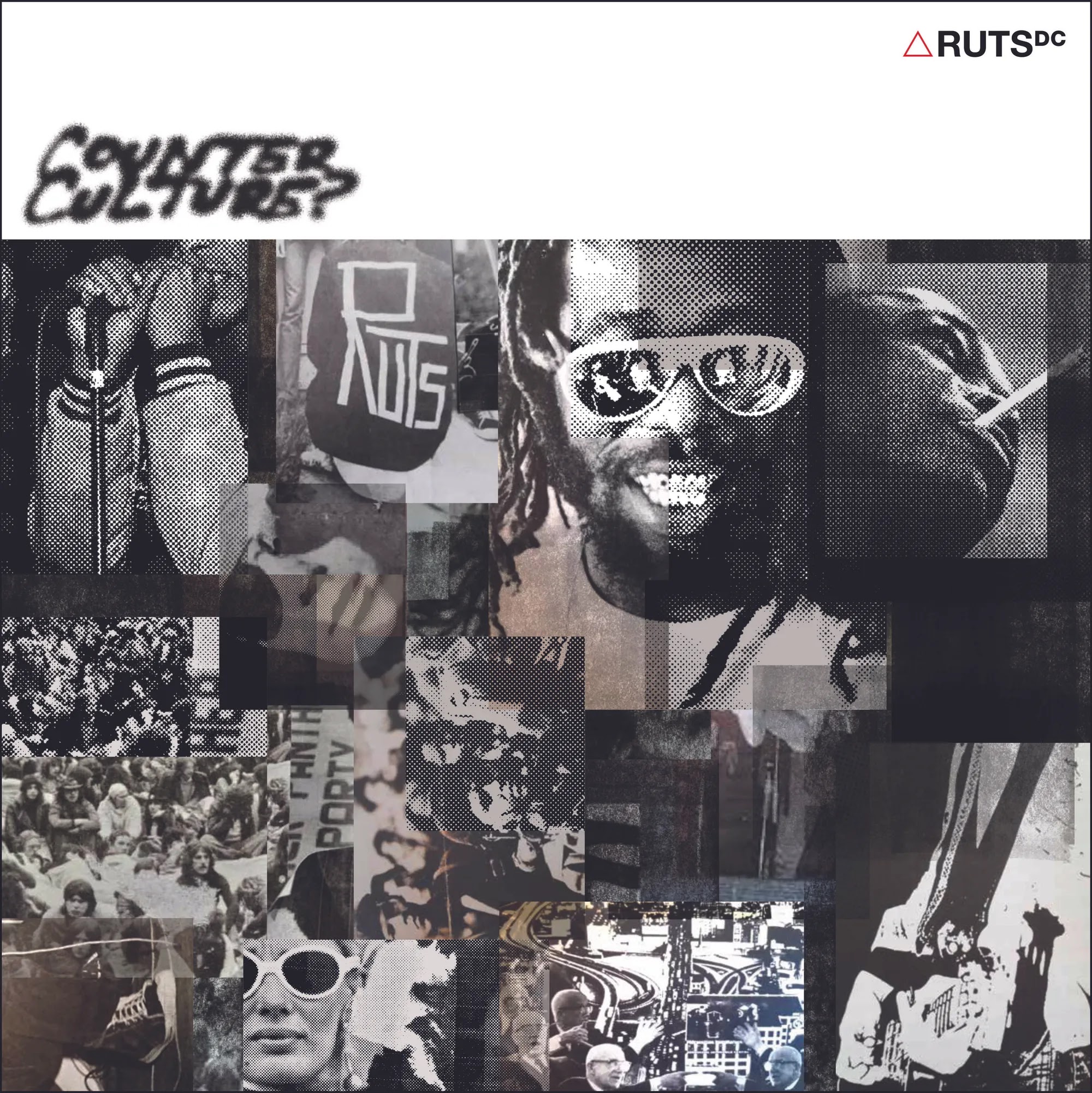
And a new Ruts DC album. Counterculture? ‘Was there ever an age with more reason to rebel?’

That’s a quote from an interesting accompanying text in the press release, which may be in the album’s artwork, asking questions about counterculture; what it is, what it comprises of. In many ways, Dunstan Bruce’s one man show ‘Am I Invisible Yet’ asks similar questions from the perspective of an ageing/aged anarchist. What does living in a way that prefigures a better tomorrow look like? How do we keep that vision of a better society alive? What have we learnt (are learning) that we can use now to help bring about a better future?

You’ve been on Facebook, you’ve read the comments, you know that ‘the punk scene’ can be just as reactionary, just as right wing, just as bigoted as the world around it. The Ruts DC text continues to remind us that the counterculture doesn’t consist of fashion accessories or events attended, you can’t buy it. It consists of individuals in networks/communities living lives based on, and expressing, a different set of values, a different social vision, a different set of social relations from the discourse that shapes the society, the mindset, around them. On this album Ruts DC reaffirm their position as part of that Counterculture.

The album kicks off with ‘Faces in the Sky’, a sense of unease pervades the track, like walking home sober waiting for things to kick off around you, "This a song for the dispossessed. The undiagnosed and the great unblessed. Brothers and sisters have we come to this? Have we come to this?" Surveillance, drones, A.I. Who to believe? The experience of the disempowered. Our own complicitity/ignorance, "Most of you people are fucking clueless". Althusser’s ISA and RSA (2). As openers go this sets the bar extremely high.

‘Caught in the Kill Zone’ keeps the pace up, "10,000 tears must fall, take me back where I belong. 10 million standing strong, again, again, again, again. 10,000 tears must fall, take me back where I belong. 10 billion standing strong’...Born alone and we’re caught in the kill zone. For too damn long we been caught in the Kill Zone". Seems to be about the love/hate relationship with place, how it can constrain us, how we and place can be mutually constitutive, reproducing each other.

 ‘X Ray Joy’ is lyrically and musically superb, acoustic guitar, "Bored and ignored we pick up the sword. The sword cuts the word and the word is adored, But sometimes the words open the door to the pain". Initially I wondered if this song was about Malcolm Owen but "I can’t pretend I ever knew you well" and "She’s lost control gotta sing out" made me reconsider. It’s a beautiful, powerful song to people we’ve known.

 "I ask the question-I get no answer, I ask the question-I get no answer. Who is the servant and who is the master. I ask the question, I asked a question’...We are not servants, we serve no master, we are not servants, we serve no master". ‘The Question Is…’ explores themes of power and hidden truths.

‘Born Innocent’ in some ways sums up the first side of the album, themes of questioning, of power, of questioning power. Some of the lyrics are in the form of a prayer which seem to be questioning organised religion while asserting some of the core values of Jesus’ teachings of treating other people as you would like to be treated. It also asserts that people cannot be reduced to their physicality, there is more to a person than their body. Intriguing track. Slower paced, it sets the scene musically for a lot of the second side.

The title track ‘Counterculture?’ starts side two with "I get stressed before I’m even dressed, I must confess it’s a very testing time. I’m distressed cos I’m under duress, we gotta stay untied yet unified…What happened to the Counter culture? The dreams they sold yer, the lies they told yer? What happened to the voice of freedom? That kept us breathing. Did we stop believing?" ‘Counterculture?’ picks up some of the themes explored in ‘Kill the Pain’, of Derrida’s concept of hauntology, a sense of nostalgia for lost futures (3). "...Got to break the chain to stay in the game"

The rest of side two is slower paced without the quality never dropping, remembrance of significant encounters and relationships, toxic relationships and/or a swipe at an ex-PM on ‘Poison Games’, "B liar B still"? ‘Cyclone’ is a call for unity, an expression of empathy for the struggling and the broken, while ‘Pretty Lunatics’ is a dismissal of those who the establishment would portray as impressive and important.

I wondered if Ruts DC could follow up Music Must Destroy with an album of equal quality and relevance. The good news is they have!


Ruts DC are playing:

18/11- Exeter Phoenix

19/11- Southampton Brook

20/11- Cardiff Globe 

21/11- Oxford O2 Academy

22/11- Stoke Sugarmill 

23/11- Glasgow St Lukes

26/11- Liverpool Arts Club

28/11- Sheffield O2 Academy 

29/11- Bristol Thekla

30/11- Nottingham Rescue Rooms

02/12- Birmingham Institute 

03/12- London Islington O2 Academy


 Bibliography.

  1. Pete Ringmaster, 2016, Ruts DC-Music Must Destroy, https://ringmasterreviewintroduces.wordpress.com/2016/09/02/ruts-dc-music-must-destroy/

      2. Althusser, Louis. n.d. On Ideology (London and New York NY: Verso Press).

      3. Fisher, M. (2014), Ghosts of My Life: Writings on Depression, Hauntology and Lost Futures, Zero Books, Winchester UK/Washington USA

Sunday, 23 October 2022

Test Dept. The Piper, St Leonards 21/10/22


It was quite a journey for a gig, but then you don’t get the chance to see heroic legends of post punk, Test Dept, above a pub very often. North Suffolk to St Leonards takes about four and a half hours by train, that’s quite a lot of Ian Rankin’s new book. 

Forty years of neoliberalism and especially the last twelve years of top down overt class war is starting to show in the material infrastructure and faces of England. Visually, England now resembles its economy. Inequality, poverty, large gaps in wealth; haves, have nots and the nervous, looking over their shoulders hoping they're not next. Enclaves of wealth surrounded by deprivation and desperation (1). 

Coincidentally, the Lucy Bell Gallery has an exhibition ‘I Wanna Be Me: Celebrating Music’s Greatest Punks, Rebels and Renegades’ opening the same night as the gig (2). Photos from the late 70s/early 80s: The Pistols, The Clash, The Ruts, Siouxsie Sioux, Poly Styrene, RAR. Nice people, nice atmosphere. Moral panic for sale? 'Cash from chaos' or archival artefacts of an important art movement? Both? I don’t know.

Just along the road was The Piper.

Support came from Slug Sonics, electronica and projections. I hadn’t heard anything by him before but it was visually and aurally mesmerising. With titles like ‘Complete Control’ and ‘Greed is Good’ his set was a perfect match for Test Dept and a welcome critique of contemporary UK (and wider) society, 

How do you describe a Test Dept gig? 

The sound of ten thousand protests.

The sound of the Four Horsemen of the Apocalypse galloping towards us.

The sound of the watchman.

The sound of hope and horror, 

of love and anger.

Political commentary 

and Call to Arms.

Made up mainly of a mix of tracks from Disturbance and material for a new album (I think) the band was on for about an hour and a half with long term members Graham Cunnington and Paul Jamrozy on percussion, brass, vocals and electronics, a guy doing all sorts of important things on an electronic box of tricks and a drummer so powerful that at times he reminded me of Gnod’s twin drummers of gigs a few years ago! 

This was one of the most intense, important, relevant multimedia performance art installations you will ever see. The musicians as both aural creators and canvas for a stream of projections. Visual art, sonic sculptures, nuanced intelligent interrogations of neoliberal capitalism and its baleful effects. An alarm call for a soporific society. A destruction of the Ideological State Apparatus (3).

The most important art/music/political event this year.

If you can see them, see them.


Bibliography.  


  1. https://www.ilivehere.co.uk/statistics-st-leonards-east-sussex-36317.html 
  2. https://www.lucy-bell.com/exhibition/i-wanna-be-me/
  3. Althusser, Louis. n.d. On Ideology (London and New York NY: Verso Press).

Saturday, 23 July 2022

No Machos or Pop Stars: When the Leeds Art Experiment Went Punk. Interview with Gavin Butt.


In the Intro to Simon Reynolds’ 2005
Rip It Up and Start Again: Postpunk 1978-1984 he observes ‘There are scores of books on punk rock and the events of 1976-77, but virtually nothing on what happened next’ (1), that was echoed as late as 2014 by Gavin Butt’s comment that ‘there is relatively little scholarship on the period’ (2). Over the last few years that situation has improved with a number of books on post-punk published, for instance Matthew Worley’s 2017 No Future: Punk, Politics and British Youth Culture 1976-84,  David Wlikinson’s 2016 Post-Punk, Politics and Pleasure in Britain, Mimi Haddon’s 2020 What is Post-Punk? Genre and Identity in Avant-Garde Popular Music 1977-82 and Post Punk Then and Now published in 2016, a collection of ‘talks, lectures and discussions’ (2) on post-punk edited by Gavin Butt, Kodwo Eshun and Mark Fisher. The fascinating chapter by Gavin Butt, ‘Being in a Band: Art-school Experiment and the Post-Punk Commons’, focuses on the Leeds post-punk scene which included Gang of Four, Delta 5, the Three Johns and the Mekons. The chapter contextualises the Leeds scene both culturally and institutionally recognising the importance of Leeds art schools and drawing attention to the fact that for some being in a band was seen as a prefigurative activity, opening up new possibilities of being and doing. Butt comments ‘People created bands because they wanted to change the world’ (2).

In the chapter Gavin says that he hopes his interviews and research will result in a book on the subject AND IT HAS!! No Machos or Pop Stars: When the Leeds Art Experiment Went Punk comes out in October on Duke University Press with the Intro free to read now (link below)! As you can probably tell I’m pretty excited about this book and so contacted Gavin to find out more.

Post Punk in Leeds is very specific, how did your interest in that time and place develop?

I had begun to reflect upon the history of art school post-punk around the time that the ConDem government tripled university fees in England and Wales in 2012. I got to thinking about the changing circumstances of an art education, and of university-level education in the UK, as we were moved quite abruptly by the then government from the remnants of a state-funded system to the turbocharged neoliberal one we have today.

I began to think quite specifically about what the old system made possible that the new one made difficult, even impossible. Chief amongst these things was how the new commodified reality of university education made it more difficult for students from working-class backgrounds to go to university, and certainly made it more difficult for them to study creative arts subjects – chiefly, for fear of accruing high levels of individual debt. I come from a debt-averse working-class family in the English East Midlands and yet I still went to art college in the 1980s: mainly because I was enabled to do so by the provision of a “free” education: no fees to pay, maintenance grants to be had, and even the availability of housing benefit to cover my student rent. What, I wondered, was being lost culturally as this older system of state-funded education was consigned to history, and “free” study and working-class participation in art school began to wither on the vine?

This is what got me to thinking about Leeds specifically. I’d originally wanted to go to Leeds to study Fine Art in the mid-1980s because I was a fan of The Three Johns. And I knew that two of the Johns went to art college in Leeds. Leeds was also home to two exceptional art departments in the 1970s: a libertarian one specialising largely in performance art at Leeds Polytechnic, and a radical one at the University where Marxist, feminist and critical theory were being taught from 1976 onwards. I was struck by just how many art school bands came out of these places after punk (in addition to the Three Johns: Gang of Four, Scritti Politti, Delta 5, Fad Gadget, Soft Cell, The Mekons, Household Name and many others…). I was struck doubly so because nobody had written about any of this. I wanted to know how an art education, and the state-funded system in which it was offered, conspired to help make all this possible in the first place.

What were the particular ‘historical conditions’ (3) in Leeds at that time that created the environment for the emergence of so many significant post punk artists? Was there a unique convergence of various factors?

Yes there was. I’ve already begun to lay this out to some degree I guess. I would say it was a particular conjuncture (as Gramsci would say) of these two exceptional art departments and the mixing of students from different social classes therein - alongside student disillusionment with the avant-garde and the counterculture. All of this was then then detonated by the testy example of punk rock which came to Leeds in the shape of the Anarchy in the UK tour in December 1976. Punk seemed to many Leeds art students at this time to offer an answer, a sense of possibility, to the elitist dead-ends of the art world.

In Christina Kiaer’s wonderful book Imagine no Possessions: the Socialist Objects of Russian Constructivism she quotes Rodchenko and explores the question ‘What would the qualities of a socialist (non capitalist) object be in contrast to the object under capitalism?’ The idea of objects as promoting ‘egalitarian socialist culture’ rather than capitalist values (4). Do we see something of that same discussion going on in the Leeds post punk scene regarding music?

This is a super interesting connection. Yes, in a way, is the answer. I write about how music-making by art students in the mid-seventies emerged in part from the collapse of earlier egalitarian hopes for what we might call anti-object work – the conceptual and performance art of the early 1970s. In chapter 1 of No Machos I trace the beginnings of both Mekons and Gang of Four to a collective piece of performance art made by members of both bands whilst students at Leeds University. Performance art was, however, quickly viewed by all involved to be an anti-capitalist object form whose cultural power was dissipating on the eve of punk and was quickly abandoned as an artistic “dead-end”. Conceptual art – that other immaterial or anti-object practice - was important to people like Green Gartside and the early incarnation of Scritti Politti. Gartside found a way of carrying a practice of intellectual contestation birthed in conceptual art’s challenges to bourgeois art discourse into music culture. In the book I chart how Scritti Politti shifted the terrain of this practice of questioning away from Art & Language toward Music & Language, precisely in order to sustain it as a politically efficacious, viable practice in the wake of punk.

You comment in Post Punk Then and Now that for some ‘being in a band…became a way of living, a mode of existing even, through which an alternative future could be glimpsed’ (2). Being in a band as a prefigurative practice, allowing other ways of working, the opening up of new possibilities, and even seeing it as ‘prefigurative of alternative ways of organising society’ (2, 5). Could you expand on this for us?

This goes right to the heart of what No Machos or Pop Stars is about. Perhaps above all, this is what ends up being most significant about art students making popular music: that they take the formal inventiveness of making art objects to what I call the “band-work,” to experimenting with e.g. non-hierarchized and egalitarian forms of group connectedness as ground for their music. This is instanced variously in the book. For example, I look at how Soft Cell reimagine the strategy of avant-garde aesthetic juxtaposition in the hybrid “electro soul” of tracks like Tainted Love and in themselves as an oddball music duo (by 1970s rock standards at least: Marc Almond gay, gregarious and emotional; Dave Ball straight, quiet and technical). I also look at how this gets played out on the dance floor at the Leeds Warehouse in the early eighties, where members of different sub-cultural tribes came together as a crowd and moved to Almond’s “mutant” DJ-mix of musical genres on the decks. Relatedly, I look at how Delta 5 send up the strictures surrounding female participation in seventies rock music by having two women bassists rather than the customary lone female bass player, and how Gang of Four aimed to create the sound of a democratic, disputatious collective - as if it might be possible to hear the different “views” of individual band members as music.

In Post Punk Then and Now you also commented on how a particular musician alluded to the idea of the artist as collectivist worker or artisan simultaneously locating himself outside of the individualism of neoliberalism and in opposition to the lone, (often male) genius of post Renaissance art (2) Did Leeds post punk more generally explore these questions of art practice, modes of art production, the gendered figure of the artist?

Yes. I think Leeds post-punk was really trying to create forms of coming together in bands which eschewed the machos theatrics of both cock rock and the transgressive individual male artist. Importantly I think a lot of the energy driving this stemmed from well beyond the art college context in DIY punk rock but also in the practices and politics of the alternative left in Leeds, which was particularly strong in cooperativism and feminism in the 1970s (with the founding of SUMA, the wholefood collective, and the emergence of strong strands of both socialist- and revolutionary forms of feminism in the city). Mekons, Delta 5 and Gang of Four in their earliest incarnation tried to frustrate the hierarchies and identities of individual bands and band members by performing in various different formations, sometimes switching instruments amongst themselves as they did. The Mekons also initially tried to take on the music press by refusing posed images of the collective and only giving individual names of band members in the manner of e.g. Mary Mekon or Kevin Mekon.

You comment in the Intro to No Machos or Pop Stars that the aim of some of the Leeds post punk bands was to encourage fans to ‘become self conscious about the larger societal structures in which they were caught’...‘while dancing to a Situationist beat’ (5). What were the main cultural/political influences on post-punk? Art history, left politics, feminism, preceding counterculture, punk, working class experience?

All of these things in complex conjunction. They were variously influenced by the virtues of pop music and punk rock production, situationism, collectivism and cooperativism, Marxism, feminism, critical theory, Rock Against Racism, performance art and queer theatre (Fad Gadget owed a debt to Lyndsay Kemp’s mime) and emerging club-culture – all during a heightened period of politicisation in the city.

In Networks of Sound, Style and Subversion, Nick Crossley writes about the importance of the density of networks in the emergence and sustainability of a ‘music scene’ (6). Was that something you identified in Leeds, clusters of people and institutions that sustained the post punk scene?

Yes. Towards the end of the book I acknowledge all of the work that’s been done recently by other scholars of UK popular music, including Crossley and Matthew Worley, in providing accounts of punk and post-punk scenes beyond London. Worley in particular lists elements of regional infrastructure that made punk and post-punk music scenes both possible and sustainable and includes things like record shops and clubs, local record labels and recording studios, fanzines and music venues. What I add to this list in Leeds is an account of how the city’s unique cluster of radical and avant-garde art schools fed into this infrastructural mix. I focus on how the policy of state-funded education provided many on the Leeds scene with the resources of intellectual and cultural capital, but perhaps above all, with the time to be able to make music in bands freed from the yoke of employment. Of course, these particular elements of the scene were hardly sustainable, as the post-war educational settlement was already being unpicked even before Thatcher achieved office in 1979, and such forms of educational freedom have now largely vanished today in the contemporary UK academy, especially for students who have to work while they study to pay their way.

In the Intro you also mention how by post punk a false dichotomy was being propagated around punk that authentic working class identity excluded higher education (5). Was this the start of the reductive idea of working class identity as excluding education and politicisation? Do you think this story supported the neoliberal dismantling of working class political organisation and the move to construction of identity around consumption?

Interesting. There is so much to say on this issue, more than I can say here.

I guess punk might have been responsible for emboldening an already circulating idea of the working-class as essentially, and authentically, uneducated. But, put more positively, this might better be understood as youth culture beginning to find ways of valuing working-class culture, especially subculture, on its own terms rather than see it only through the eyes of establishment institutions (like universities) and (often outraged) middle-class society. That is why so many art students were skeptical of institutionalised forms of education I think in the punk era – because universities and Polytechnics were seen as organs of the ruling elites of the technocratic state. Working class youth culture, on the other hand, offered possibilities of self-organisation, and forms of protest music and dissident forms of identity and appearance, that opened up the possibilities of gender, race and sexual expression beyond the available identities in traditional class cultures and in traditional forms of politics.

Punk and post-punk, therefore, certainly didn’t suggest a lumpen working-class. Quite the contrary. They could be seen instead as expressions of what the late Mark Fisher used to call “popular modernism”: forms of experiment and resources of transformational political possibility located within popular, rather than elite, culture.

But I did also want to tell the important story of working-class participation in education, within 1970s institutions, and how education itself was being transformed as a result of this in some instances. Emboldened by the Worker’s Education Authority and perspectives from the burgeoning field of Cultural Studies, working-class participation in higher education had the effect of reimagining its purpose beyond it being simply as a route into the egg head middle-class in favour of making it into a space for imagining genuine forms of alternative world-making and of social and cultural transformation.

The legacy of all this clearly shouldn’t be that reductive image of the working class as politically regressive and as under- or un-educated (which perhaps has flashed up particularly vividly in recent years in media reporting around Brexit). I like to think my book might modestly resist this image hardening into what we think we “know” of working-class culture and working-class people by providing an historical image of cross-class artistic and musical experiment that contradicts it.

There has been a revival of the post punk sound since the early 2000s but it has often been less overtly political. In Inventing the Future (7) Srnicek and Williams make the point that cultural change often precedes political change. Have you come across many contemporary bands that have the concerns you identify in the book, that take the process of production and musical form seriously?

What springs most immediately to mind is the work that is being done / has been done over the past ten years by people who are in bands but who are also involved in collectively organizing and running social spaces and art and music venues in increasingly capitalised city spaces. This is perhaps where the impetus of a kind of “neo-post-punk” persists most strongly, with the need being acute for self-organized spaces and forms of mutual aid for contemporary music artists beset by neoliberal austerity and the post-pandemic downturn. From Chunk in Leeds to the Rose Hill in Brighton, to the recently defunct DIY Space for London and the Old Police Station in Gateshead, these spaces are as vulnerable to gentrification and closure as they are needed by those who populate them. Such spaces resonate with the sounds that run the gamut of contemporary musical expression - from neo-punk, noise, turntablism, experimental and electronica, to contemporary gospel, funk, alt-country, improvisation and folk – and, as such, they might provide us with the closest thing we have right now to the cross-genre experimentation of the post-punk days. But art education no longer seems to play the pivotal role it once did in shaping all of this. Perhaps we have Nick Clegg to thank – or blame – for this. At least we might start the process of our reckoning with him.


Many thanks to Gavin for his time, the link to No Machos Or Pop Stars Intro is here https://www.dukeupress.edu/Assets/PubMaterials/978-1-4780-1863-6_601.pdf?fbclid=IwAR1HfnJhoQJfGr60gjNQyf0SmkfrttJA80NE4jqXMU-2OTSu0N1e3e0snJE

And you can preorder the book here https://www.dukeupress.edu/no-machos-or-pop-stars or here https://www.amazon.co.uk/No-Machos-Pop-Stars-Experiment/dp/1478016000 


Bibliography.

(1) Reynolds, Simon (2005). ‘Rip It Up and Start Again: Post Punk 1978-1984’ (London: Faber and Faber).

(2)  Butt, G. (2016) Preface, Introduction and Being in a Band: Art-school Experiment and the Post-Punk Commons - a Lecture by Gavin Butt (16/10/14) in Gavin Butt, Kodwo Eshun and Mark Fisher, eds, ‘Post-Punk: Then and Now’, Repeater Books, London.

(3)  Wilkinson, D. (2016) ‘Post-Punk, Politics and Pleasure in Britain’, Palgrave Macmillan, London, p. 11.

(4)  Kiaer, C. (2005) ‘Imagine No Possessions. The Socialist Objects of Russian Constructivism’, The MIT Press, Cambridge, MA, USA, p. 1.

(5)  Butt, G. (2022) ‘No Machos or Pop Stars: When the Leeds Art Experiment Went Punk’, Duke University Press, Durham, North Carolina, USA. Preface and Introduction https://www.dukeupress.edu/Assets/PubMaterials/978-1-4780-1863-6_601.pdf?fbclid=IwAR1HfnJhoQJfGr60gjNQyf0SmkfrttJA80NE4jqXMU-2OTSu0N1e3e0snJE

(6)  Crossley, N. (2015) ‘Networks of Sound, Style and Subversion: The Punk and Post-Punk Worlds of Manchester, London, Liverpool and Sheffield, 1975-80’, Manchester University Press, Manchester.

(7)  Srnicek, N. and Williams, A. (2015) ‘Inventing the Future: Postcapitalism and a World Without Work’, Verso. London UK and Brooklyn, NY, USA.

Sunday, 13 March 2022

Tangerine Dream. Cambridge Corn Exchange. 12 March 2022.


I really am no expert on Tangerine Dream I’ve acquired
Rubycon (1975) and Phaedra (1974) over the last 10 years or so and been periodically intrigued by the complexity and shifting patterns on the two albums, the evoking of the mysterious and the eerie, the sheer peculiarity of early Tangerine Dream’s music. When I saw they were playing Cambridge Corn Exchange I was interested to see if they could still do it, I bought a couple of tickets and also thought I should get up to speed on the last 45 years or so! I got hold of Quantum Gate (2017) and was seriously impressed. According to Tangerine Dream’s website ‘In late summer 2014, Edgar Froese, Thorsten Quaeschning, Ulrich Schnauss and Hoshiko Yamane began to work on what was planned to be the first album of Tangerine Dream’s Quantum Years – a new phase of the band that Edgar wanted to use to introduce a couple of substantial changes. Consisting of himself, long term collaborator Thorsten Quaeschning (synths & musical director), violinist Hoshiko Yamane and new member Ulrich Schnauss (synths), the Quantum Years promised an updated, contemporary take on the band’s trademark sound of the 70s and 80s: sequencer-driven electronica covering a wide range of moods and atmospheres from ambient soundscapes to energetic, upbeat moments. Non-musical ideas relating to the field of quantum physics and philosophy had inspired Edgar to attempt a translation of these concepts into music’ (1). In 2015 Froese, the last remaining original member of the band died, but Quaeschning, Yamane and Schnauss pushed on to realise this vision (1). The result is an album that’s the equal of those early records. 

On 25 February this year Tangerine Dream, now Quaeschning, Yamane and Paul Frick, released the new album Raum (the German word for ‘space).

We get to the Corn Exchange early, the demographic of the crowd is pretty much as expected, predominantly post 50 which is fine by me, nice to not feel old at a gig now and then, but a good smattering of 20/30 somethings. For at least 45 minutes before the band come on stage there is a ferocious storm projected onto a back screen which seems to grow in intensity over time (though I’m pretty sure it was looped). My partner, who’s from Barrow-in-Furness, felt instantly at home!  

 At 8 pm Tangerine Dream, looking relaxed and amiable, dressed all in black stroll on stage. Thorsten Quaeschning says ‘Good evening, Cambridge’ and we’re off. Now this is where you want me to identify songs, provide a setlist, tell you about instruments. I can’t. I think they played ‘You’re Always on Time’ and ‘Raum’ from the new album as I recognised the accompanying videos.There were computers and keyboards and a violin. Throughout the set both the lighting and projections were extraordinary, sometimes abstract shapes, sometimes video footage the visuals perfectly complimented the music. But despite the visuals I found myself returning to the gently swaying figures, the charismatic Quaeschning is center stage, looking like an amiable, benevolent version of Snape. He’s flanked by Yamane and Frick, the former on violin and electronics, the latter on keyboards.

But more interesting, more important is what a Tangerine Dream concert does. 

The two hours were a lot more rhythmic and uptempo than I was expecting, drawing on techno beats (I think) to propel the evening along. About three songs in I realised I was listening to something special (and this is where it all gets a bit subjective), I have rarely, if ever, heard music so kind, so generous, so gracious. At points in the evening it was an encounter with the sublime. I actually felt a sense of hope as I listened to their music, that despite war and climate change and perpetual inequality and oppression maybe, just maybe, the human race could have a positive future after all. (Writing this the day after it sounds a bit odd, but that was what it did.) There is a biography of Dorothy Day called The World Will be Saved By Beauty, for two hours I believed there was truth in that. I don’t think it was a particularly ’spiritual’ experience as much as an encounter with the best aspects of the human ‘soul’. An important reminder as a global pandemic segues into additional war.

 At 9.55pm Tangerine Dream went off, and then back on for an encore. We caught the first 15 minutes before having to leave for the train back to Norwich.

 The Virgin to Quantum Years tour should be made available on prescription, an evening of mesmerising beauty.


Bibliography.

(1)  https://www.tangerinedreammusic.com/en/music/detail.asp?id=6&tit=Quantum+Gate

      (2)  Hennessy, Kate. (2017) Dorothy Day: The World Will be Saved By Beauty: An Intimate Portrait of my Grandmother, (Scribner). 

Saturday, 11 December 2021

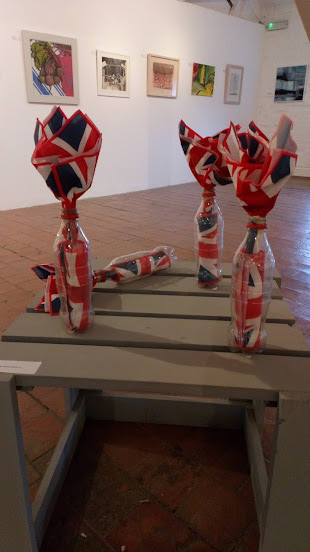
Psychogeographic Autoeroticism II


In the book 'The System of Objects' Jean Baudrillard comments that 'The erotic significance of the object (a car) here plays the same role as the image (real or mental) in masturbation' (1).

In the book 'Imagined Communities' Benedict Anderson described the nation as an 'imagined community (2)', a socially constructed imagination.
Nationalism and masturbation seem to have similar characteristics as they both involve the subject exciting themselves over an image or imagination. In this piece the bottle is obviously phallic but overall it attempts to capture the similarity between nationalism and masturbation without being too overt.
The four bottles stand for the four nations of the UK, the fallen bottle representing England which, mesmerised by nationalism and xenophobia, in 2019 elected another Tory government despite 10 years of top down class war known, euphemistically as austerity. The coke bottles can also be taken to represent the historical and contemporary influence of USA in British culture and economics.


(1) Baudrillard, J. (1996) 'The System of Objects', Verso, London and Brooklyn. p.73 
(2) Anderson, B. (1991) 'Imagined Communities; Reflections on The Origins and Spread of Nationalism' Verso, London and New York.